
Reviewed · CATANIA OLD TOWN WALKING TOURS
Catania Walking Tour with Audio and Written Guide by a Local
Catania, but guided by your phone. This self-guided audio and written walking route strings together the city’s key sights in a smart order, from Ursino Castle down to the Benedictine Monastery, with a lot of context you would miss if you just wander.
I especially like the flexible pace—you can pause, linger, and move at your own speed because it’s not tied to a live group. And I love that the guide builds in practical extras like local restaurant advice plus multilingual audio and text, so you’re not just collecting photos.
One heads-up: this is not a guided-by-a-person tour, so if you dislike smartphone-based navigation or you forget to activate the guide details, you’ll lose a lot of value from the experience.
In This Review
- Key highlights worth your attention
- How This Catania Self-Guided Route Keeps You Moving
- Ursino Castle: Start at the Square and Read the Lava Walls
- A’ Piscaria Mercato del Pesce: The Quick Hit Fish Market Moment
- Fontana dell’Amenano: Carrara Marble with an Underground Twist
- Piazza del Duomo and Catania Cathedral: Baroque Meets the Earthquake Story
- Piazza Università: Bronze Lamp Legends You Can Actually Spot
- Optional Anfiteatro Romano Under Piazza Stesicoro: A 4€ Detour That Fits
- Via dei Crociferi: The Street That Feels Like a Movie Set
- Benedictine Monastery of San Nicolò l’Arena: The Walk’s Calm Finale
- Price and Value: Why 7.83€ Makes Sense
- Smart Tips Before You Start (So the Guide Actually Works)
- Best Fit for Your Style of Travel
- Should You Book This Catania Audio Walking Tour?
- FAQ
- How long is the Catania walking tour?
- Is there an in-person guide with you?
- What languages are available?
- Do I need headphones?
- Is the Roman theatre ticket included?
- Where does the tour start and end?
- Can I cancel and get a full refund?
Key highlights worth your attention
- Audio + text in multiple languages (Eng, Esp, Ita, Ger, Fr) so you can switch formats as you go
- Free admission for most stops, which makes the low price feel even better
- Optional Roman theatre visit (Anfiteatro Romano) for 4€, with the rest of the route already set
- Legends built into the route, like the bronze lamp characters in Piazza Università
- You choose the rhythm, since it’s self-paced and not scheduled like a classic group tour
How This Catania Self-Guided Route Keeps You Moving

This walking tour is built around a digital guide you use on your smartphone, with both audio and written support. There’s no in-person guide walking beside you. Instead, your phone becomes the “guidebook on your feet,” with a route you can follow stop-by-stop, plus tips tied to what you’re looking at.
The price is low enough that you should think of it as a paid walking script, not a pricey tour. You’re paying for the structure and the explanations—plus local restaurant suggestions and quick history/cultural context at each stop. The free admission at most sites also helps the value math.
A practical note that matters: you’ll need internet on your phone to use the guide, and headphones are not included. You can hear the audio through your phone’s speakers, but earphones often make the experience more comfortable in busy streets.
Group size is capped at 104 people, but you’re not clustered up like a big bus tour. Since you’re following your own timing, the group dynamic matters less than it would on a guided tour.
More of baroque Catania on foot, from Via Etnea to the Duomo.

Ursino Castle: Start at the Square and Read the Lava Walls
Your walk begins at Ursino Castle in Piazza Federico di Svevia. This castle sits in a large central square, and that matters because it gives you an immediate “orientation moment” before the route turns into smaller historic lanes.
I like the way this stop frames Catania’s identity through stone. The castle’s outer walls are made from well-cut and regularly arranged lava-stone blocks, while an inner wall is described as more irregular. That difference is the kind of detail that turns a quick photo stop into real understanding.
Another thing you’ll pick up here: the castle’s name is described as still uncertain, and it’s tied to Frederick II of Swabia, whose name is attached to the square. The guide context also points out that the building once stood closer to the sea, protected by a moat and other defensive structures. Even without going deep into the fortress story, that single perspective shift helps you look at the site like it belonged to a different Catania—one shaped by water, defense, and volcanic material.
Plan on about an hour at this first stop. If you rush it, you miss the payoff.
A’ Piscaria Mercato del Pesce: The Quick Hit Fish Market Moment
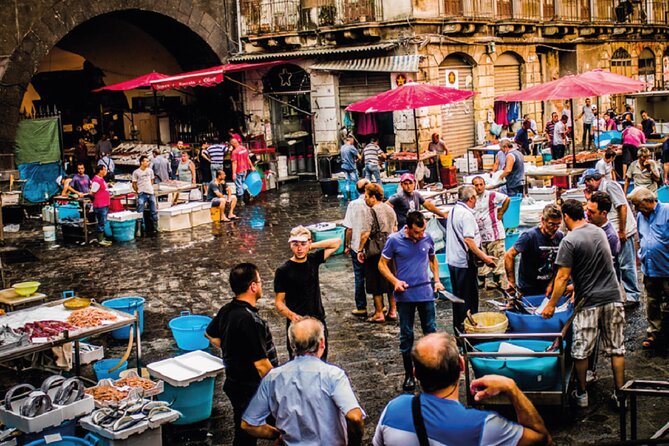
Next is A’ Piscaria (Mercato del Pesce), Catania’s famous fish market area near Piazza del Duomo and the Fontana dell’Amenano. Even if you don’t buy anything, it’s a strong snapshot of everyday city life.
This stop is short—about 20 minutes—so use the time for simple, grounded observations: the location, the flow of people, the market’s pace, and how it fits into the historic center around it. You’ll also get the local term Piscarìa and the Sicilian-dialect context, which makes the market feel less like a generic tourist stop.
If you’re sensitive to smells, go prepared. A fish market is a fish market. But it’s also a fast way to feel how locals move through the city’s heart.
Fontana dell’Amenano: Carrara Marble with an Underground Twist
After the market, you’ll reach Fontana dell’Amenano. It’s a quick 10-minute stop, but it’s the kind of place that sticks because the story is specific.
The fountain was created in 1867 by the Neapolitan sculptor Tito Angelini, using Carrara marble. More importantly, it’s dedicated to the Amenano, the underground river that flows under the city of Etna. That’s the sort of detail that changes how you read the surface level of Catania: there’s a hidden water story under your feet.
Because the time here is brief, don’t treat it as a “pass-through.” Take a minute to connect what you hear on the audio track with what you see in front of you—marble, fountain setting, and that underground river idea.
Piazza del Duomo and Catania Cathedral: Baroque Meets the Earthquake Story
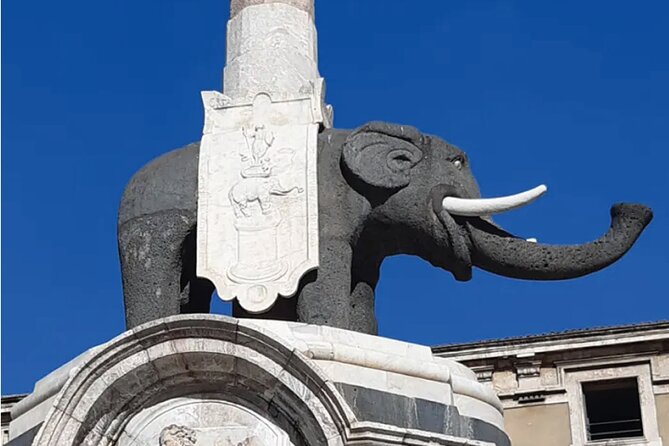
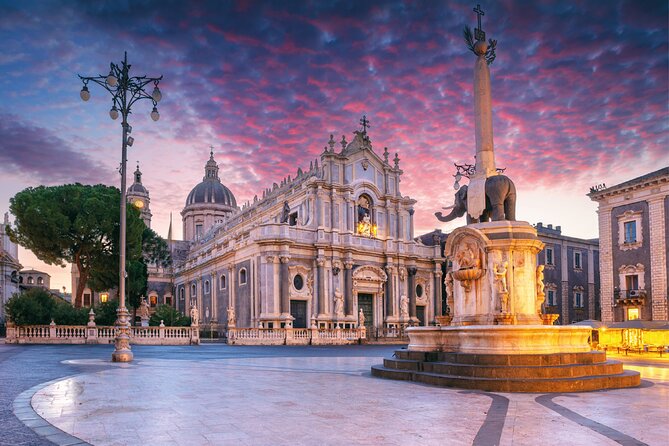
Then comes Piazza del Duomo, the beating heart of Catania’s historic center, and the Cathedral of Sant’Agata.
This area is ideal for the self-guided format because you can pace yourself. You’ll spend about 20 minutes at the cathedral and roughly 20 minutes in the square overall.
What makes the cathedral particularly worth your attention is the timeline:
- Built in 1090 on remains of an ancient Roman temple dedicated to Jupiter
- Later rebuilt after the devastating earthquake of 1693 destroyed much of the city
- Recognized as an important example of Baroque architecture
That sequence—Roman roots, then Baroque rebuild after a major seismic event—helps you understand why the city feels layered rather than frozen in one era. It’s also a reminder that Catania’s architecture is partly an answer to what the ground has done.
The square itself is where you get the mood. If you want the best experience, step back, take in the whole ensemble, then come closer for details. The audio and text are built for that rhythm.
More Catania days out with a local guide.



Piazza Università: Bronze Lamp Legends You Can Actually Spot

Next you’ll reach Piazza Università, named after Palazzo degli Studi, also known as Palazzo Università. One of the most memorable features here is visible immediately: four bronze lampposts placed at the corners.
The guide turns those lampposts into characters from Catania legends:
- Gammazita, the young figure
- Cola Pesce, the sailor linked with underwater skills
- The brothers Anfinomo and Anapia
- The legendary paladin Uzeta
This is a great stop to slow down for a few minutes, because the legend is half the experience. It’s not just art for art’s sake—it’s local storytelling placed right in your walking path.
You’ll only spend about 10 minutes here, so be intentional. Look at the lampposts, then use the audio cues so you know who you’re looking at.
Optional Anfiteatro Romano Under Piazza Stesicoro: A 4€ Detour That Fits

Under Piazza Stesicoro, you’ll find the Anfiteatro Romano (Roman theatre). The tour doesn’t enter as part of the main route. Instead, it flags it as an optional visit, which you can do on your own with a ticket.
The guide context sets the stakes: this ancient theatre dates to the 1st century BC, and it was later submerged over the centuries by eruptions of Etna and by seismic events. That’s a powerful idea—history literally buried, then rediscovered in the city you walk today.
Ticket cost isn’t included: 4€. If you’re curious and your schedule is flexible, it’s worth considering. If you’d rather keep the walk smooth and simple, you can skip it and still get a complete route experience.
Via dei Crociferi: The Street That Feels Like a Movie Set
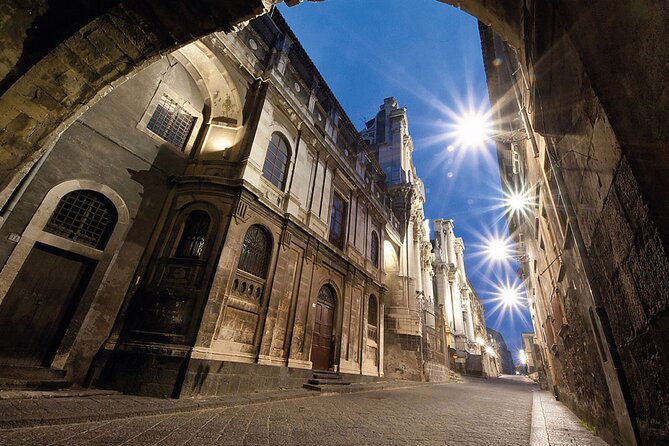
Now it’s time for Via dei Crociferi, one of Catania’s oldest and most evocative streets. The guide pitches it for its cinematic charm, and I agree with the logic: this is the kind of street where buildings feel designed for dramatic framing.
This stop is short—about 10 minutes—so you’re not supposed to “tour” it like a museum. Instead, use the time to appreciate how the street connects monuments and textures. Watch for the architecture rhythm and the way the road pulls your eye forward.
It’s also a good spot to turn off the audio for a moment and just absorb the atmosphere. The guide gives you context, then you can decide how much time you want to spend in the visuals.
Benedictine Monastery of San Nicolò l’Arena: The Walk’s Calm Finale
Your endpoint is the Benedictine Monastery of San Nicolò l’Arena, at Piazza Dante Alighieri. This is where the route finishes, and it’s a strong place to end because it’s described as a major city reference point—especially in the 18th century—thanks to its grandeur and rich rooms.
This stop is about 30 minutes, which is long enough to make a real difference here. It’s also a fitting finale because it shifts the focus from street and plaza life into a more reflective setting.
A useful context detail from the guide notes: the monastery is tied to the noble origins of the monks who lived there, and it became significant through the monastery’s scale and interior richness. Even if you’re not a deep art/architecture person, that kind of story gives you a framework for what you’re seeing.
Admission here is listed as free, so you’re getting a high-feel ending without extra ticket costs.
Price and Value: Why 7.83€ Makes Sense
At $7.83 per person, this tour isn’t priced like a “premium guided experience.” It’s priced like value: a low-cost way to structure your walk, keep you oriented, and give you meaningful context without hiring a person guide.
Here’s where the value comes from:
- Most stops have free admission
- You get audio plus written material in several languages
- You receive tips on monuments, history, and curiosities
- The guide includes best local restaurant advice with authentic food ideas
- It’s connected to Google Maps, which can help you navigate efficiently between stops
The main things not included are also clear:
- Anfiteatro Romano ticket (4€)
- Headphones (you’ll use your phone speakers or your own headphones)
Time-wise, it runs about 3 to 4 hours. That’s a sweet spot: long enough to cover major highlights without eating your entire day.
One more smart value tip: the walk is self-paced, so you’re not forced to “keep up.” If you take 10 extra minutes at a fountain or a cathedral, you’re still generally fine. This makes the experience easier for mixed pacing groups—people who want photos and people who want stories.
Smart Tips Before You Start (So the Guide Actually Works)
Because this is digital-first, the setup is part of the experience. You’ll activate the guide using details in your voucher, and you’ll need a smartphone with an internet connection.
Also, plan to get to Ursino Castle as your starting anchor at Piazza Federico di Svevia, 21. One review concern you should take seriously: if you arrive late or from the wrong direction, you can end up walking out of order and retracing steps. Google Maps plus the exact start address fixes most of that.
If you like audio, consider using your own earbuds even though headphones aren’t included. Phone speakers work, but in a city center you’ll often want better clarity.
A small tactic I recommend: skim the next stop’s name quickly before you reach it, then press play. That way, the moment you look up, the audio connects instantly.
Best Fit for Your Style of Travel
This experience suits you best if you like:
- Exploring at your own pace
- Short stops where the story matters as much as the view
- A walk-based day plan that doesn’t require booking a guide meeting time
- Learning the “why” behind places like the cathedral and Amenano fountain
It’s less ideal if you want:
- A live person to answer questions on the spot
- A tour that stays tightly within a timed group schedule
- Zero smartphone dependence
If you can handle basic phone use and you’re okay with choosing your own rhythm, this format is a good match.
Should You Book This Catania Audio Walking Tour?
I think this is a strong booking for Catania first-timers who want the highlights in a sensible order, plus context that makes the sights feel connected. The free admissions across most stops keep your costs predictable, and the multilingual audio/text gives you flexibility if you’re traveling with someone who prefers a different format.
Book it if you’re the type who likes to wander—then wants the wandering guided. Skip it only if you’re the type who dislikes using your phone for directions and audio, or if you know you won’t read the activation instructions before you start.
FAQ
How long is the Catania walking tour?
It takes about 3 to 4 hours on average.
Is there an in-person guide with you?
No. The experience uses a digital guide with audio and written content, not a live guide.
What languages are available?
The audio-guide and text are available in English, Spanish, Italian, German, and French.
Do I need headphones?
Headphones are not included. You can listen through your smartphone speakers or use your own headphones.
Is the Roman theatre ticket included?
No. The Anfiteatro Romano ticket is not included and costs 4€.
Where does the tour start and end?
It starts at Ursino Castle, Piazza Federico di Svevia, 21, 95121 Catania and ends at the Benedictine Monastery of San Nicolò l’Arena, Piazza Dante Alighieri, 32, 95124 Catania.
Can I cancel and get a full refund?
Yes. You can cancel up to 24 hours in advance for a full refund. If you cancel less than 24 hours before the start time, the amount isn’t refunded.
More Tours in Catania






More Tour Reviews in Catania

More Catania Old Town Walks

After something different? More tours and day trips around Catania and eastern Sicily








Catania Old Town Walking Tours, compared.
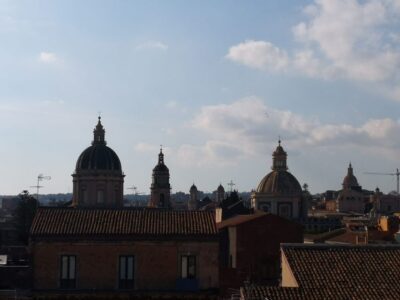 ★ 4.6Heart of the City Guided Walking TourFrom $23708 reviews
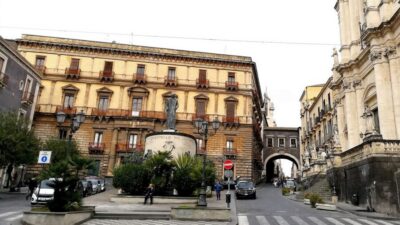 ★ 4.7City Highlights Walking TourFrom $14666 reviews
 ★ 4.6Underground Catania Tickets and Guided TourFrom $29536 reviews
 ★ 4.8Benedictine Monastery of Catania – English Guided TourFrom $11434 reviews
 ★ 4.9Street Food Guided Walking TourFrom $56326 reviews
 ★ 4.7Guided Street Food Walking TourFrom $58300 reviews
 ★ 5.0Syracuse, Ortigia and Noto walking tour from CataniaFrom $129273 reviews
 ★ 4.8The heart of the City – Tour guidato in ItalianoFrom $23171 reviews
Browse the lists this tour appears in